
Good communication plays a crucial role in integrating foreign car mechanics in Germany and impacts workplace performance – But how quickly can a productive language level be achieved?
Why Language Is Important in the Workshop
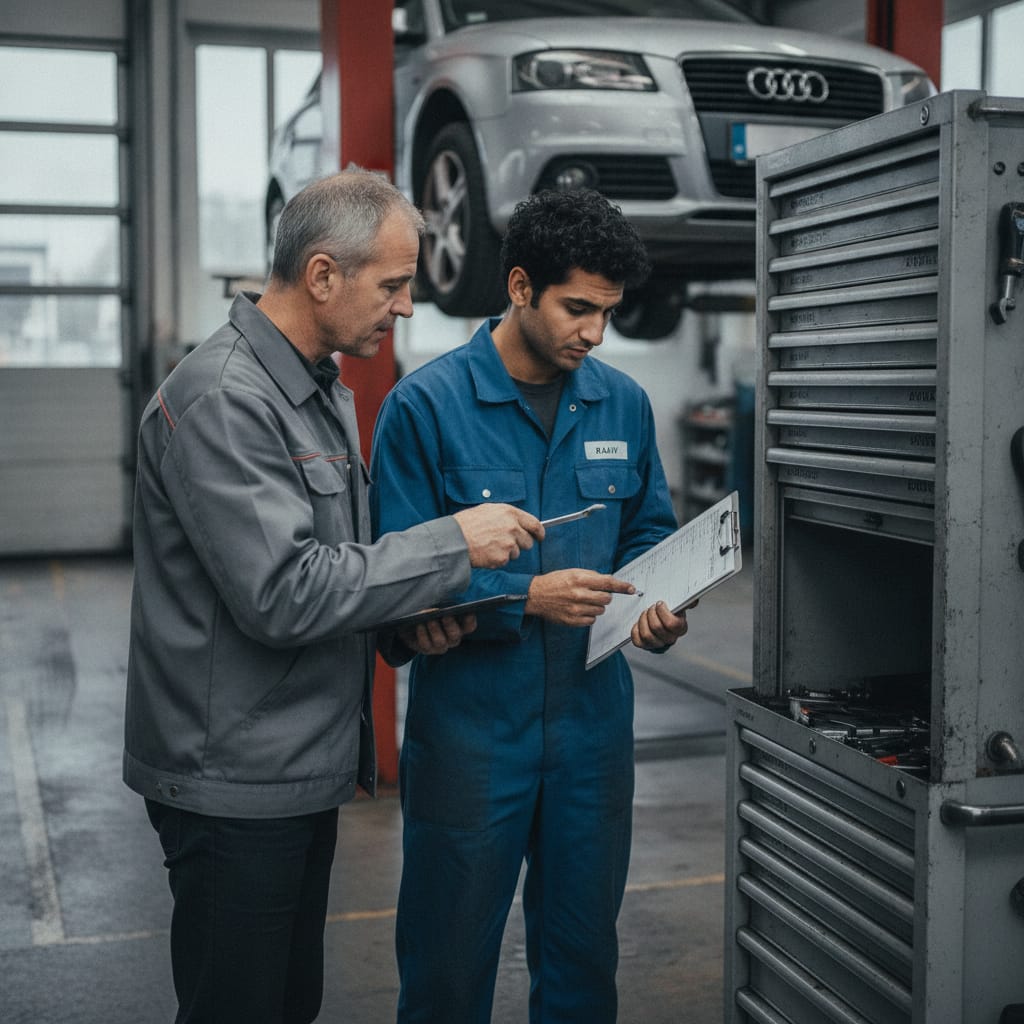
In the workshop, language determines whether instructions are understood the first time, defects are documented correctly, and safety protocols are followed even under time pressure. Technicians who can reliably communicate with supervisors and colleagues integrate into the team faster and are more resilient.
However, good language skills aren't just advantageous at work. They are also central to daily life in Germany. They reduce everyday friction, simplify the search for housing, and enable participation in public and private opportunities.
Legally, there are no requirements
A surprising but pleasing fact: The legislator does not generally require foreign automotive mechatronics technicians to provide formal proof of language skills when entering the country. If the process is correctly set up under the Skilled Workers Immigration Act, work can begin entirely without an official language test. For you as an employer, this means significant relief and planning certainty – the anxious wait to see if the new skilled worker passes their exam on time is no longer necessary. However, it is evident that focused language preparation for the real-world workshop environment remains indispensable.
How the CEFR Levels A1 to C2 Are Applied in Hiring Automotive Technicians
The Common European Framework of Reference for Languages divides language proficiency into six levels from A1 to C2. A levels cover "basic language use," B levels "independent language use," and C levels "highly proficient language use." For employers, this framework is useful because it links recruitment expectations to specific communication tasks, rather than vague impressions of good German skills.
The right language threshold is the one that enables safe, repeatable workshop performance.
What German Level Is Sufficient in the Workshop
For workshop roles that do not involve regular customer contact, a language level of A2 to early B1 is a realistic and recommended target. The reason is practical: Workshop communication is repetitive, task-oriented, and easier to standardize than front-desk communication. With a stable vocabulary for tools, vehicle components, defects, and safety instructions, collaboration can work well even before full conversational fluency is reached.
A language level of A2 is particularly sufficient if your workshop separates customer communication from technical execution. For instance, if a service advisor manages intake and explanations for customers, foreign employees can initially focus on diagnostics, repairs, inspections, and internal handovers. Especially during the onboarding phase, limited language proficiency can be effectively offset by a clearly defined, workshop-specific basic vocabulary. If technical terms for routine tasks, common components, error messages, and standard phrases for colleague inquiries are established in advance, new employees can handle these tasks quickly and confidently on their own.
How Quickly This Level Can Be Achieved
To reach the A2 language level, approximately 150 to 260 lessons (each 45 minutes) are typically needed. In an intensive full-time course, this goal can be achieved within two to three months. If language acquisition takes place alongside work, a timeframe of six to twelve months is realistic. For workforce planning, the rule of thumb is: Think in months, not weeks. This might initially seem like a long period but offers a crucial advantage: This learning time can be ideally synchronized with the waiting period for official work permits or visas. This way, the time until the actual work start is optimally utilized, and your new skilled workers will be linguistically well-prepared on their first day.
How the Time Until the Visa Can Be Used for Language Preparation
The period between your decision to hire and the first workday is about 3-5 months when using the fast-track skilled worker procedure. This time can be optimally used to make significant progress toward the A2 language level or even to achieve it.
And this is exactly where we come in: Our language courses are designed to prepare your new skilled workers precisely for the workday in your company. Since everyone learns differently, we first evaluate prior knowledge to ensure a flexible start at the exact right level – for quick progress without over- or under-demanding. We combine everyday integration courses with targeted professional language so that your employees can quickly settle into life in Germany and communicate confidently on the job right from the start. Our special focus, however, is on practice: Imagine your new skilled worker entering the workshop on their first day already familiar with your internal processes and tool terms. To achieve this, we analyze the required technical jargon with you in advance. Our instructors then integrate this specific vocabulary into the curriculum and intensively train it in role-playing scenarios. We don't stop at general German – we teach the language of your business.